Three findings that should keep every European webshop awake at night
2026-06-03 · ShoppingPartnerLab Research · Research
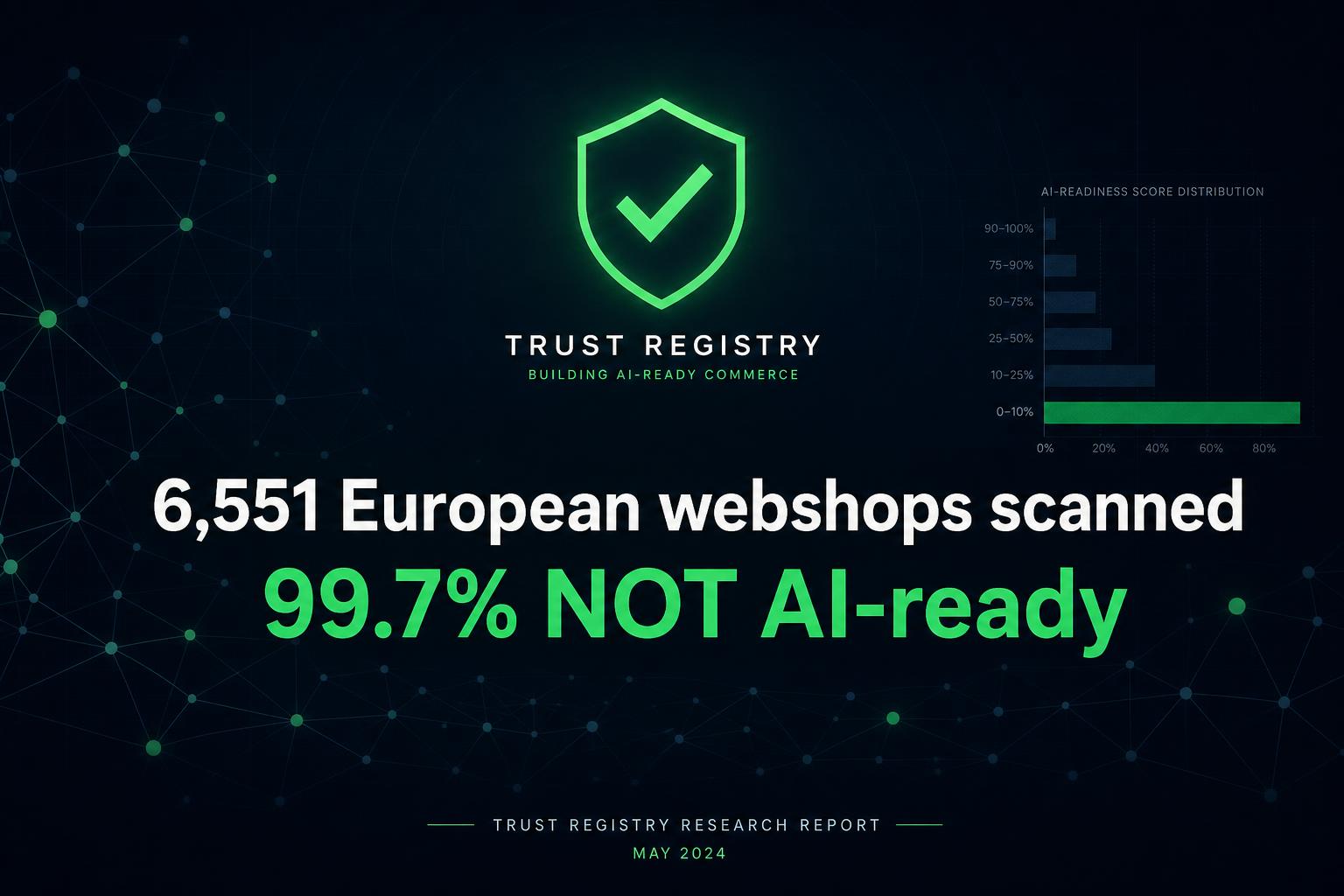
We just published the largest independent AI-readiness audit of European e-commerce — 6,551 shops, 24 countries, 16 sectors, validated by three independent AI models. The full report runs 14 chapters. This article is the part you should read first.
Three findings stand out. Each is, on its own, a strategic emergency. Together they explain why only 14 of 6,551 shops score above 80 out of 100, and why the average AI-readiness score sits at a stubborn 32/100.
1. 44% of European webshops are invisible to AI agents — full stop
2,191 of the 6,551 shops we scanned serve their homepage as an empty JavaScript shell. The first paint contains a `<div id="root"></div>` and a JS bundle that, given enough seconds and a real browser, eventually renders product information.
AI crawlers from Google, OpenAI and Perplexity do not execute JavaScript. They never get to that second paint. For these 2,191 shops the AI Visibility sub-score collapses to 3.7/100 — versus 40.5 for server-rendered shops.
This is not an SEO nuance. It is a binary state: the shop either exists in the agentic economy, or it doesn't. When an AI agent asks "where can I buy this product in the Netherlands?", these 2,191 shops are not in the answer set. They cannot be ranked lower; they are not ranked at all.
The fix is not exotic. SSR, ISR, or simply a pre-rendered HTML snapshot served to bot user-agents puts a shop back on the map.
2. The 112× token-efficiency gap is the real ranking signal
A median product page contains roughly 9,000 tokens of HTML. The same product information — name, price, availability, GTIN, brand, condition, shipping — expressed as JSON-LD Product schema takes around 80 tokens. A 112× efficiency multiplier.
Why does this matter? Because production AI shopping systems are already designed to route around the LLM whenever they can. When clean structured data is present, the agent serializes it directly into the cart workflow and skips the inference call entirely. That saves roughly 99% of the compute cost of that transaction.
Multiply by millions of agent-mediated transactions per day and the economics become brutal: shops with structured data are cheap to transact with; shops without are economically unprofitable to process. The agent does not punish you with a lower rank. It silently removes you from the candidate set, because including you would lose money.
Our data confirms it: shops with Schema.org markup score 53.8 on average; shops without score 35.8. That 18-point delta is the single strongest predictor of AI-readiness we measured — bigger than framework choice, bigger than country, bigger than sector. Yet only 278 of 6,551 shops (4.2%) currently expose Product schema.
3. The case study: 35 → 86 in 28 days, without replatforming
The cheapest counter-argument to the report is: "fine, but fixing this takes a six-month replatforming project". The dataset says otherwise.
One Dutch mid-market retailer in our sample went from an AI-readiness score of 35 to 86 in 28 days. They did not switch e-commerce platforms. They did not hire a new agency. They worked through the prioritised remediation list that the free scan produces, in order:
- Week 1 — Server-side rendered the homepage and category pages. AI Visibility sub-score jumped from 8 to 62.
- Week 2 — Added Product schema, Organization schema, and BreadcrumbList. Schema sub-score from 12 to 88.
- Week 3 — Filled missing H1s and meta descriptions across 240 templates. Content sub-score from 41 to 79.
- Week 4 — Published `/llms.txt`, added the company knowledge graph block, claimed their Trust Registry listing. Trust & Authority sub-score from 30 to 85.
Total cost: in-house dev time only. No new vendors. No platform migration. The case is in the report (anonymised) precisely because it shows the remediation list is operationally tractable.
What this means for the next 90 days
Google's Universal Cart is live. The Agent Payments Protocol (AP2) is live. The agents are not coming — they are here, and they are already routing transactions. The window in which "being on the open web" was sufficient to be discoverable closed at Google I/O 2026.
The remediation is well understood and, in most cases, weeks of work — not quarters. The 14 shops above 80 in our dataset are not exotic operations. They are mid-market shops that took machine-readability seriously six months ago.
Two things you can do today, both free:
- Run the AI-Readiness Scan — 60 seconds, scored across 40+ signals, returns the same prioritised remediation list the case-study retailer used.
- Claim your AI Trust Registry listing — your shop is almost certainly already in the registry (all 6,551 scanned shops are). Claiming it surfaces your verified status to AI agents via `/llms.txt` and the registry API.
For the full methodology, sector breakdowns, country cuts and the remaining 11 chapters, the complete research report is open and free to download.